For a kitchen backsplash, an offset (running bond) layout is the simpler, cheaper choice: rows run level, cuts are mostly square, and less tile goes to waste. A 45° herringbone reads as more deliberate and more patterned, but nearly every tile at an edge needs an angled cut, so it takes more labor and more overage. Tile manufacturer Fireclay Tile, for example, recommends ordering 15% extra for field tile such as subway and 20% for herringbone. With small tiles like the ones most backsplashes use, the ANSI offset limit for long rectangular tile doesn’t apply, so the choice between the two is mainly about looks and budget.
How each layout reads
Offset (running bond) lays rectangular tiles in level rows, each row shifted along from the one below. The horizontal lines lead the eye along the wall, which suits long runs of counter and makes a backsplash feel calm. It also tolerates small imperfections at the cabinet line, because the top row is one straight cut.
45° herringbone sets tiles in a zigzag of interlocking Vs, angled to the counter. It adds movement and draws attention to the backsplash, which helps when the tile is the main feature of the kitchen. It competes more with busy counters or veined slabs, and it makes every edge (the counter, the underside of the cabinets, the window casing, outlets and side walls) a visible line of angled cuts.
The size of the room matters too. On a short wall with many interruptions, the herringbone pattern gets broken into small pieces. On a clear, wide wall, it has room to read.
The tiles one kitchen compared
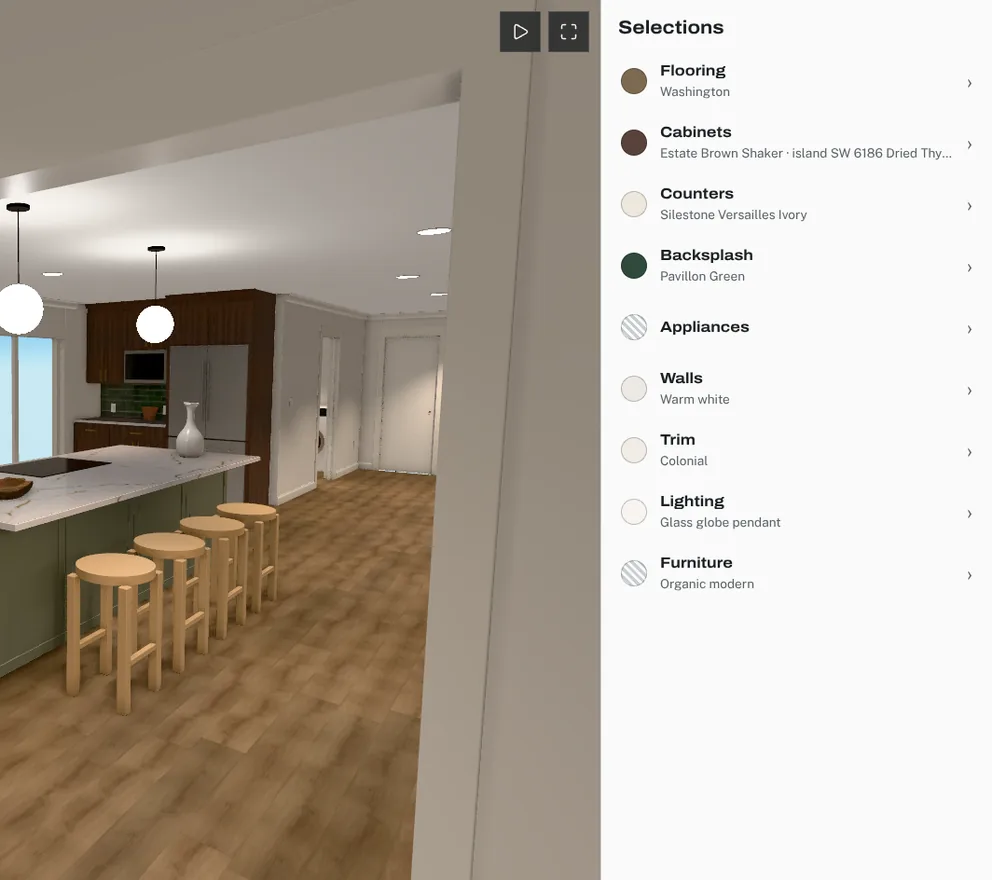
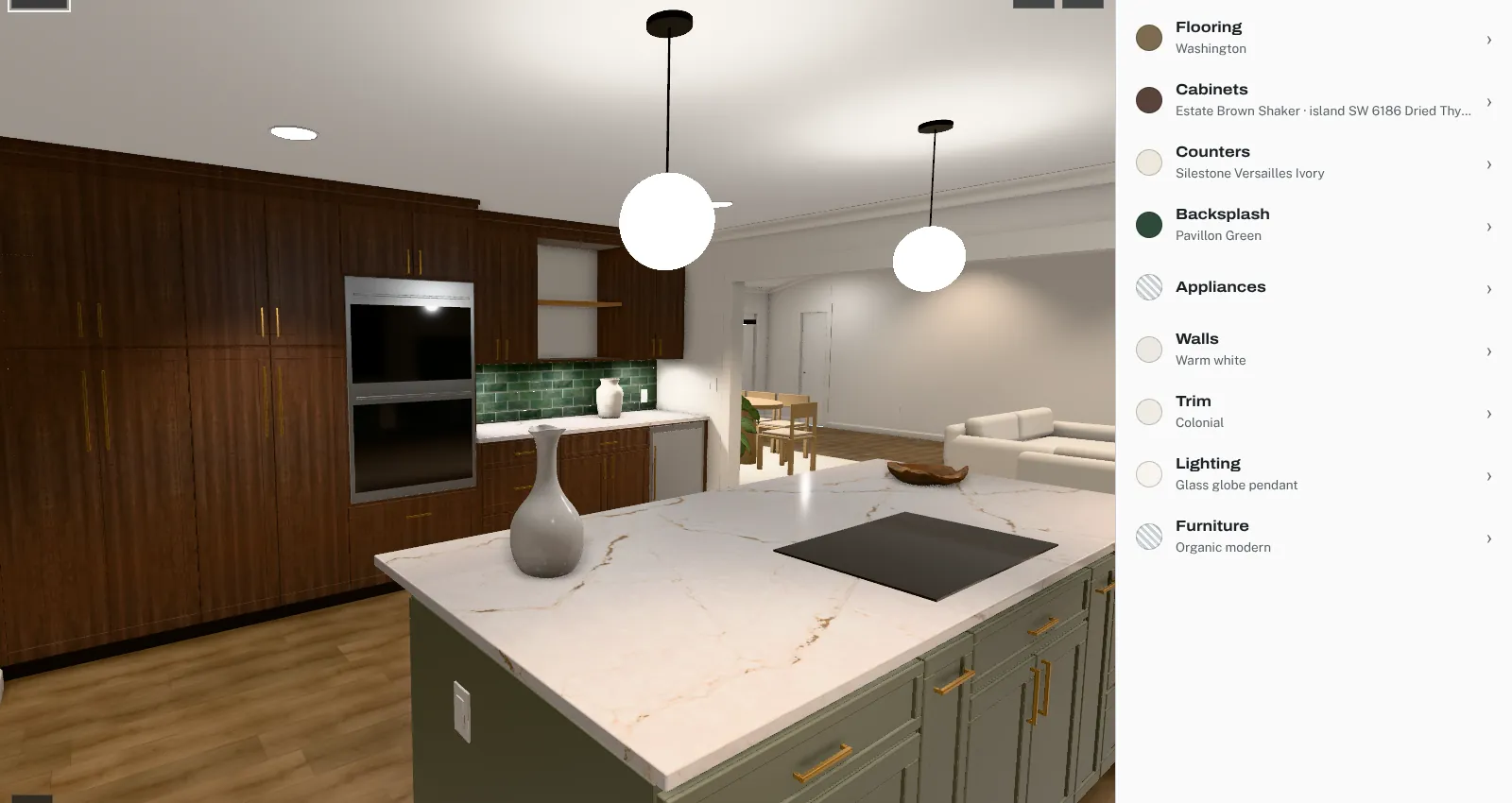
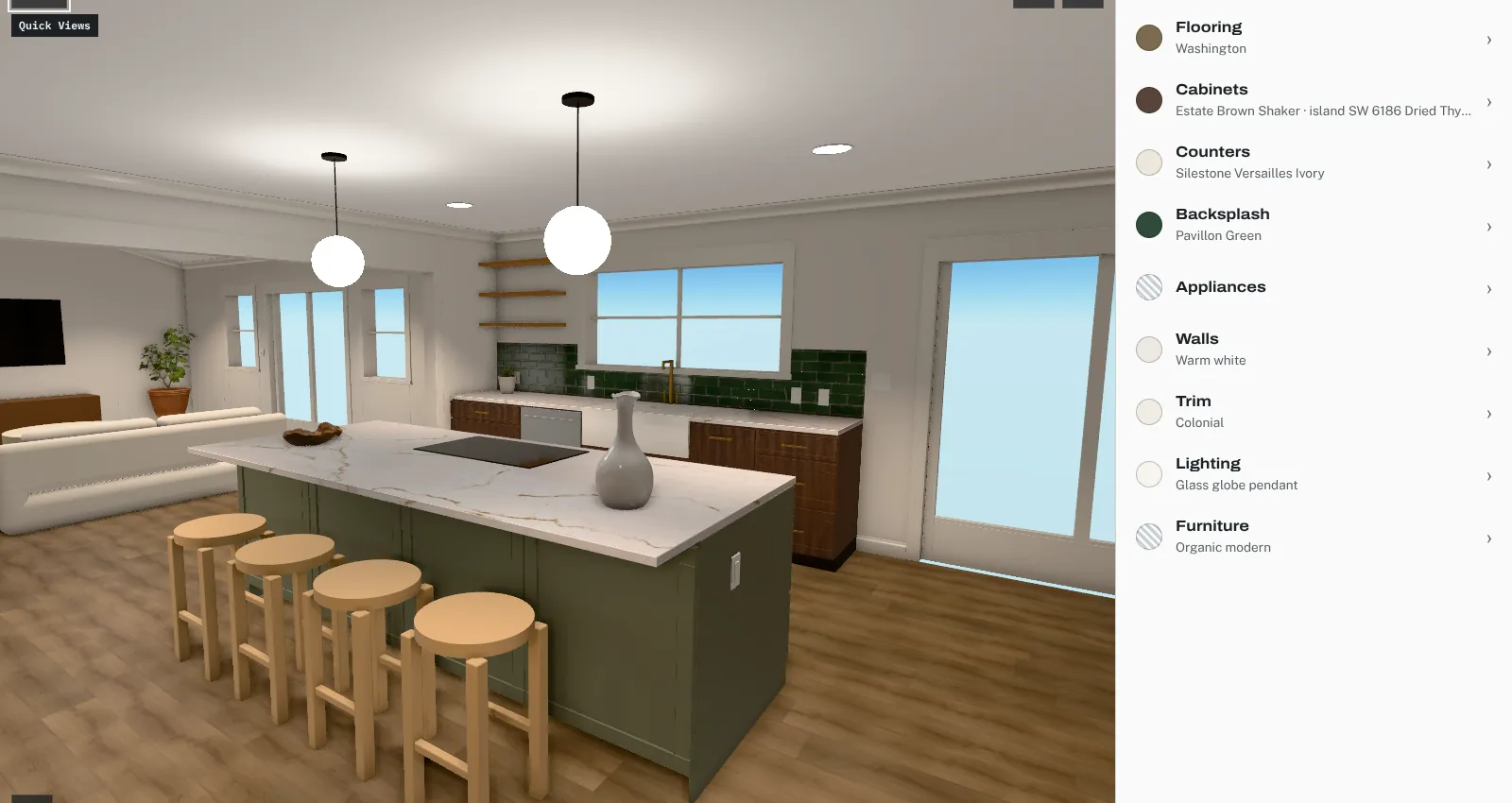
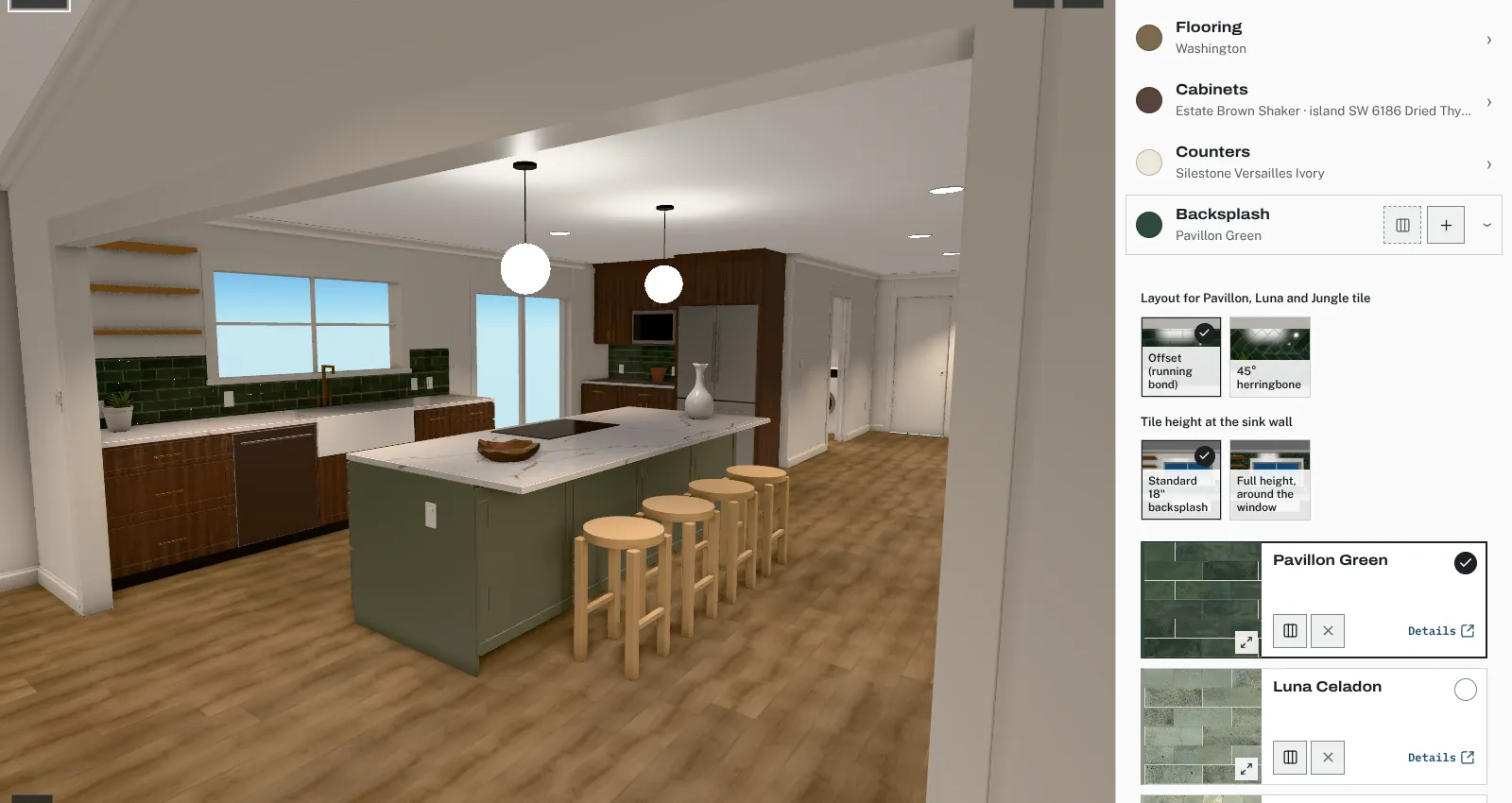
The kitchen remodel Coffered was built around let the client switch three tiles between offset and 45° herringbone in the 3D room, laid out at true size from each product’s photos:
| Tile | Size | Material and finish | Installed estimate |
|---|---|---|---|
| Pavillon Green (Tile Club) | 2.75” × 8.05” | Ceramic | $18.99–$23.99 per sq ft |
| Luna Celadon (Tile Club) | 2.58” × 7.9” | Glossy ceramic, made in Spain, high shade variation | $21.40–$26.40 per sq ft |
| Heritage Jungle (FEQ10HTJG) | 2⅜” × 9⅝” | Matte porcelain | $27.61–$32.61 per sq ft |
Each installed estimate is the retailer’s per-square-foot price plus an installation labor range of $10 to $15 per square foot. A fourth tile, a marble hexagon mosaic on sheets, had no layout choice because the sheet sets the pattern.
The backsplash measured 29.4 sq ft at the standard 18-inch height. A second height option, full height around the sink window up to the 94-inch ceiling, added 23.2 sq ft.
Laying both patterns on the actual wall shows things a sample board can’t: how the herringbone’s angled cuts land against the window casing, how the offset rows line up with the cabinet bottoms, and how a high-variation glossy tile like Luna Celadon looks across a whole wall next to a matte porcelain.
Cuts and waste
The ANSI A108.02 installation standard, as quoted by the Ceramic Tile Education Foundation (CTEF), says to “make all cuts on the outer edges of the field” and that “an excessive amount of cuts shall not be made.” Both layouts can meet that. The difference is how many edge cuts each layout produces, and how complex they are.
- Offset: cuts fall at the ends of each row (straight, square cuts) and along the top row under the cabinets. Offcuts from one row end can often start the next row.
- Herringbone: every tile that meets an edge needs a 45° cut, and the triangular offcuts are harder to reuse. Outlets and switch boxes inside a herringbone field need notched angled cuts.
Fireclay Tile’s ordering guidance reflects this: “A specialty shape or a pattern, like herringbone, will require far more cuts than a stacked or offset pattern,” and it recommends 20% overage for herringbone against 15% for field tile. Other manufacturers and installers may recommend different allowances, so ask the installer what they want on site.
Box sizes can absorb part of the difference. Using the remodel’s 29.4 sq ft and those two allowances:
- Pavillon Green (5.6 sq ft boxes): 15% calls for 33.8 sq ft and 20% for 35.3 sq ft. Both are 7 boxes.
- Luna Celadon (5.38 sq ft boxes): both allowances are 7 boxes.
- Heritage Jungle (5.78 sq ft cases): 15% is 6 cases; 20% is 7, one more case at $101.80.
So for this wall, the extra tile for herringbone cost little or nothing. The real difference is labor. The remodel’s estimate said so directly: “herringbone adds cuts and waste, not priced.” The herringbone premium had to come from an installer’s quote rather than a per-square-foot range.
Lippage and the one-third offset rule
Lippage is the difference in height between the edges of neighboring tiles. ANSI allows long tiles some warpage, and CTEF attributes lippage in running bond to “the inherent warpage on the long side of the tile.” Its guidance is that a 33% offset “significantly reduces lippage” compared with a 50% offset.
ANSI A108.02, section 4.3.8.2, addresses this. As quoted by CTEF in 2025 and by Stone World in 2024, the rule applies “where the side being offset is greater than 15” (nominal dimension),” and “the offset pattern will be a maximum of 33% unless otherwise specified by the tile manufacturer.” Any larger offset requires the specifier and owner to approve a mock-up and the resulting lippage. Arizona Tile’s installation guidance states the same 15-inch threshold. Note that older references give a different number: a 2015 International Masonry Institute article quotes the same section with an 18-inch threshold. If a spec cites the rule, check which edition it uses.
The same section sets minimum grout joints for these long tiles in running bond: on average at least 1/8 inch for rectified tile and 3/16 inch for calibrated tile, widened by the amount of edge warpage.
None of the remodel’s three tiles is longer than 9⅝ inches, well under the 15-inch threshold. For typical backsplash tiles, the one-third rule is not a requirement, and a half offset or a one-third offset is a design choice. It becomes a real constraint when a backsplash uses large-format tile, such as 4 × 16 or 3 × 24.
Grout
For tiles of the same size and joint width, herringbone doesn’t need much more grout per square foot than offset. Every tile is still surrounded by the same joint, just turned 45°. What changes is how the joints read: offset joints form long horizontal lines and short vertical ones; herringbone joints form a continuous zigzag. A contrasting grout emphasizes either pattern; a matching grout lets the tile color carry the wall.
Cost
Using the remodel’s numbers, the standard-height backsplash came to roughly $558 to $705 installed in Pavillon Green offset, $629 to $776 in Luna Celadon and $812 to $959 in Heritage Jungle. Those are estimates from retailer prices and published labor ranges, not quotes. Herringbone adds installation labor that a per-square-foot range doesn’t capture. Ask for a separate line for the pattern so the client can see what it costs.
How to decide
- Choose offset when the tile itself has strong color or variation, the wall has many interruptions, or the budget is tight.
- Choose herringbone when the wall is wide and clear, the tile is fairly uniform, and the backsplash is meant to be the focal point.
- With tile longer than 15 inches, keep a running bond offset at no more than one-third unless the manufacturer says otherwise.
- Price herringbone from an installer’s quote, not from a per-square-foot range.
- Look at both layouts on the actual wall, with its window, outlets and cabinet line, before deciding.
Where Coffered fits
Coffered is a pre-launch subscription app for interior and remodel designers. It publishes a client design center from the designer’s own 3D model, where the client can switch a backsplash option, compare up to three options side by side and see each option’s client price in a running total before approving a version.
Sources
- Tile School: How to Avoid an Add-On Order (Fireclay Tile)
- Tile Patterns Require Balance (Ceramic Tile Education Foundation)
- Offsets, Grout Joints and Customer Expectations (Ceramic Tile Education Foundation)
- Do You Know the ANSI Standards for Tile Coverage, Offset and Acceptable Lippage? (Stone World)
- Rectangular Tile Installation (Arizona Tile)
- Large Format Tile: Dealing with Lippage (International Masonry Institute)